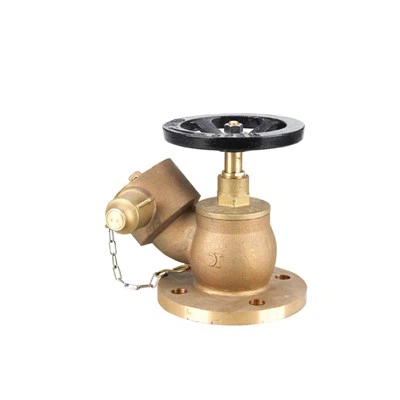
What is the flow coefficient of a fire hydrant landing valve?
As a supplier of fire hydrant landing valves, I often get asked about the flow coefficient. It is a crucial parameter that determines the performance of these valves in a fire - fighting system.
The flow coefficient, commonly denoted as (C_v), is a measure of a valve's ability to pass fluid. In the context of fire hydrant landing valves, it represents the volume of water (usually in US gallons per minute) that can flow through the valve at a pressure drop of 1 pound per square inch (psi). A higher (C_v) value indicates that the valve can allow a greater volume of water to pass through for a given pressure drop.
Let's understand the significance of the flow coefficient in a fire - fighting scenario. When a fire breaks out, every second counts. Firefighters need a sufficient amount of water to be delivered quickly to the affected area. The fire hydrant landing valve is a critical component in the water delivery system. If the valve has a low flow coefficient, it will restrict the flow of water. This means that even if there is an adequate water supply at the source, the amount of water reaching the fire may be insufficient to extinguish it effectively.
For instance, in a large commercial building with multiple floors, a fire on the upper floors requires a high - volume water supply. A fire hydrant landing valve with a high (C_v) value ensures that water can be quickly and efficiently delivered to these floors. This can significantly reduce the spread of fire and minimize damage to property and potential harm to people.
Now, let's talk about the factors that affect the flow coefficient of a fire hydrant landing valve.
Valve Design
The design of the valve plays a major role in determining its flow coefficient. There are different types of fire hydrant landing valves, such as the BS Landing Valve Oblique Type and the Straight Type Landing Valve.
The oblique - type valve has a different internal flow path compared to the straight - type valve. The shape and orientation of the passages inside the valve can either enhance or impede the flow of water. In general, a well - designed valve with smooth and unobstructed flow paths will have a higher flow coefficient. The internal geometry should minimize turbulence and pressure losses, allowing water to flow freely through the valve.
Valve Size
The physical size of the valve is also directly related to its flow coefficient. Larger valves typically have higher (C_v) values. This is because a larger valve has a larger cross - sectional area for water to flow through. For example, a 6 - inch fire hydrant landing valve will generally have a much higher flow coefficient than a 2 - inch valve. When selecting a valve for a fire - fighting system, it is essential to consider the required flow rate and choose an appropriate valve size accordingly.
Valve Material and Surface Finish
The material used to construct the valve and its surface finish can affect the flow coefficient. A valve made of a material that has a smooth internal surface will reduce friction as water flows through it. For example, valves with a polished interior will have less resistance to flow compared to those with a rough surface. This results in a higher flow coefficient. Additionally, the material should be corrosion - resistant to maintain the smoothness of the internal surface over time.
Pressure Regulating Feature
Some fire hydrant landing valves come with a pressure - regulating feature, such as the Pressure Regulating Valve. While pressure regulation is important for ensuring a stable water supply and preventing damage to the system, it can also impact the flow coefficient.
Pressure - regulating valves often have internal mechanisms that control the pressure. These mechanisms can introduce some resistance to the flow of water, which may reduce the flow coefficient to some extent. However, modern pressure - regulating valves are designed to minimize this effect and still provide an acceptable flow rate while maintaining pressure control.
Calculating the flow coefficient of a fire hydrant landing valve can be a complex process. It usually involves conducting flow tests in a laboratory environment. During these tests, the valve is installed in a test rig, and water is passed through it at different pressure differentials. The flow rate is measured, and the (C_v) value is calculated using the formula:


[C_v=\frac{Q}{\sqrt{\Delta P}}]
where (Q) is the flow rate in US gallons per minute and (\Delta P) is the pressure drop across the valve in psi.
In the real - world application, fire - fighting system designers use the flow coefficient values provided by valve manufacturers to select the appropriate valves for a given project. They consider factors such as the size of the building, the expected fire load, and the water supply capacity. By choosing valves with the right flow coefficient, they can ensure that the fire - fighting system will perform effectively in case of an emergency.
As a supplier of fire hydrant landing valves, we are committed to providing high - quality products with accurate flow coefficient values. Our valves are rigorously tested in our state - of - the - art laboratories to ensure that they meet or exceed industry standards. We understand the critical role that these valves play in fire - fighting, and we strive to offer the best solutions to our customers.
If you are involved in a fire - fighting project and need to select the right fire hydrant landing valves, we are here to help. Our team of experts can assist you in understanding the flow coefficient requirements for your specific application and recommend the most suitable valves. Whether you need a BS Landing Valve Oblique Type, a Straight Type Landing Valve, or a Pressure Regulating Valve, we have a wide range of products to meet your needs.
Contact us today to start a discussion about your fire - fighting valve requirements. We are eager to work with you to ensure the safety and effectiveness of your fire - fighting system.
References
- NFPA (National Fire Protection Association) Standards on Fire Hydrant Systems
- ASME (American Society of Mechanical Engineers) Codes related to Valve Flow Calculations
- Manufacturer's Technical Documents on Fire Hydrant Landing Valves