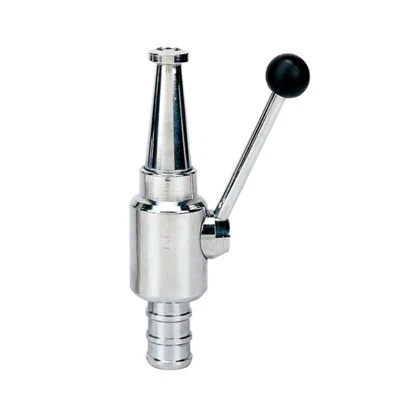
As a professional fire nozzle supplier, I am frequently asked about the intricate workings of fire nozzles within a fire truck's water system. Understanding this process is crucial not only for firefighters but also for those involved in purchasing fire - fighting equipment. In this blog, I will delve into how fire nozzles and fire truck water systems collaborate to fight fires effectively.
The Basics of a Fire Truck's Water System
A fire truck's water system is a complex setup designed to transport large volumes of water from its source to the fire. Typically, it consists of a water tank, a pump, hoses, and of course, the fire nozzle.
The water tank on a fire truck serves as a reservoir. It can hold anywhere from a few hundred to several thousand gallons of water depending on the size and type of the truck. The water can come from various sources, such as hydrants, natural water bodies, or other water supply points.
The pump is the heart of the water system. It is responsible for increasing the pressure of the water so that it can be forced through the hoses and out of the nozzle with sufficient force. Modern fire truck pumps are incredibly powerful and can generate high - pressure water flows necessary to reach the fire.
Hoses are used to transport the water from the pump to the nozzle. They come in different sizes and lengths, and their main function is to maintain the water pressure between the pump and the nozzle.
The Role of the Fire Nozzle
The fire nozzle plays a pivotal role in the fire - fighting process. It is the final component in the water delivery system, and its design and operation are critical for directing the water precisely at the fire.
The primary function of a fire nozzle is to control the flow and pattern of the water. Different fire scenarios require different water flow rates and patterns. For example, a solid stream pattern is useful for reaching fires from a distance or for penetrating through walls and ceilings. On the other hand, a fog or spray pattern is better for cooling large areas, protecting firefighters from heat radiation, and extinguishing fires in confined spaces.
Most fire nozzles are adjustable, allowing firefighters to change the water flow pattern according to the situation. They can switch between a solid stream, a wide - angle spray, and various intermediate settings. This adjustability gives firefighters the flexibility to adapt to different fire conditions.
How the Fire Nozzle Connects to the Fire Truck's Water System
The connection between the fire nozzle and the fire truck's water system is made through a hose. The hose is attached to the pump outlet on one end and to the nozzle on the other. The connection must be secure to prevent any water leakage, which can reduce the efficiency of the water delivery.
When the pump is activated, water is forced into the hose under high pressure. As the water travels through the hose towards the nozzle, it maintains this pressure. The nozzle is designed to further manipulate this high - pressure water. Inside the nozzle, there are internal components such as valves and baffles that control the water flow and shape the water pattern.
The Science Behind the Nozzle's Operation
The operation of a fire nozzle is based on the principles of fluid dynamics. When water enters the nozzle, it passes through a constricted area, which is known as the orifice. According to Bernoulli's principle, as the water flows through the constricted orifice, its velocity increases while its pressure decreases. This increase in velocity is what allows the water to be projected out of the nozzle with force.
The shape and size of the orifice, as well as the internal design of the nozzle, determine the flow rate, pressure, and pattern of the water. For example, a smaller orifice will result in a higher - velocity stream but a lower flow rate, while a larger orifice will allow more water to pass through but at a lower velocity.


Different Types of Fire Nozzles and Their Applications
There is a wide variety of fire nozzles available in the market, each designed for specific applications.
One common type is the Fire Branchpipe DN40 & DN65. These branchpipes are often used in combination with hydrant systems. They are suitable for delivering a steady stream of water at relatively high pressures, making them ideal for fighting fires in buildings and other structures.
The Red Plastic Spray Fire Hose Nozzle For Fire Fighting is another popular option. Made of durable plastic, it is lightweight and easy to handle. This type of nozzle is great for creating a wide - angle spray pattern, which is useful for cooling large areas and protecting firefighters.
The Fire Water Gun/Handline Nozzle is designed for hand - held operation. It provides firefighters with precise control over the water flow and pattern. It can be used in a variety of fire - fighting situations, from small fires in residential areas to larger industrial blazes.
Maintenance and Safety Considerations
Proper maintenance of fire nozzles is essential for their reliable performance. Regular inspections should be carried out to check for any signs of damage, such as cracks or leaks. The internal components of the nozzle, such as valves and seals, should be cleaned and lubricated periodically to ensure smooth operation.
Safety is also a top priority when using fire nozzles. Firefighters should be trained on the correct operation of the nozzles to avoid any accidents. They should also be aware of the potential hazards associated with high - pressure water, such as the risk of being knocked down by the force of the water stream.
Conclusion
In conclusion, the collaboration between a fire nozzle and a fire truck's water system is a well - orchestrated process that is essential for effective fire - fighting. By understanding how these components work together, we can appreciate the complexity and importance of fire - fighting equipment.
If you are in the market for high - quality fire nozzles, we are here to assist you. Our company offers a wide range of fire nozzles that are designed to meet the diverse needs of fire - fighting operations. Whether you need a nozzle for a small - scale residential fire or a large - scale industrial emergency, our products are built to perform. Contact us for more information and to start a procurement discussion.
References
- "Fire Protection Handbook", National Fire Protection Association
- "Fluid Mechanics for Fire Protection Engineers", American Fire Sprinkler Association